Field Notes
It is three in the afternoon in the Sonoran Desert, and it is 115 degrees. Equipment out here doesn’t fail because it’s hot. It fails because the heat quietly steals the power keeping it alive - and that distinction is the whole story.
The local crews left hours ago, which is the sensible thing to do. One of our engineers is still out there, on his feet since four in the morning, working a problem that, according to every datasheet involved, should not be happening. That gap - between the perfect day the datasheet describes and the day the desert actually delivers - is where most of the hard lessons in Physical AI live.
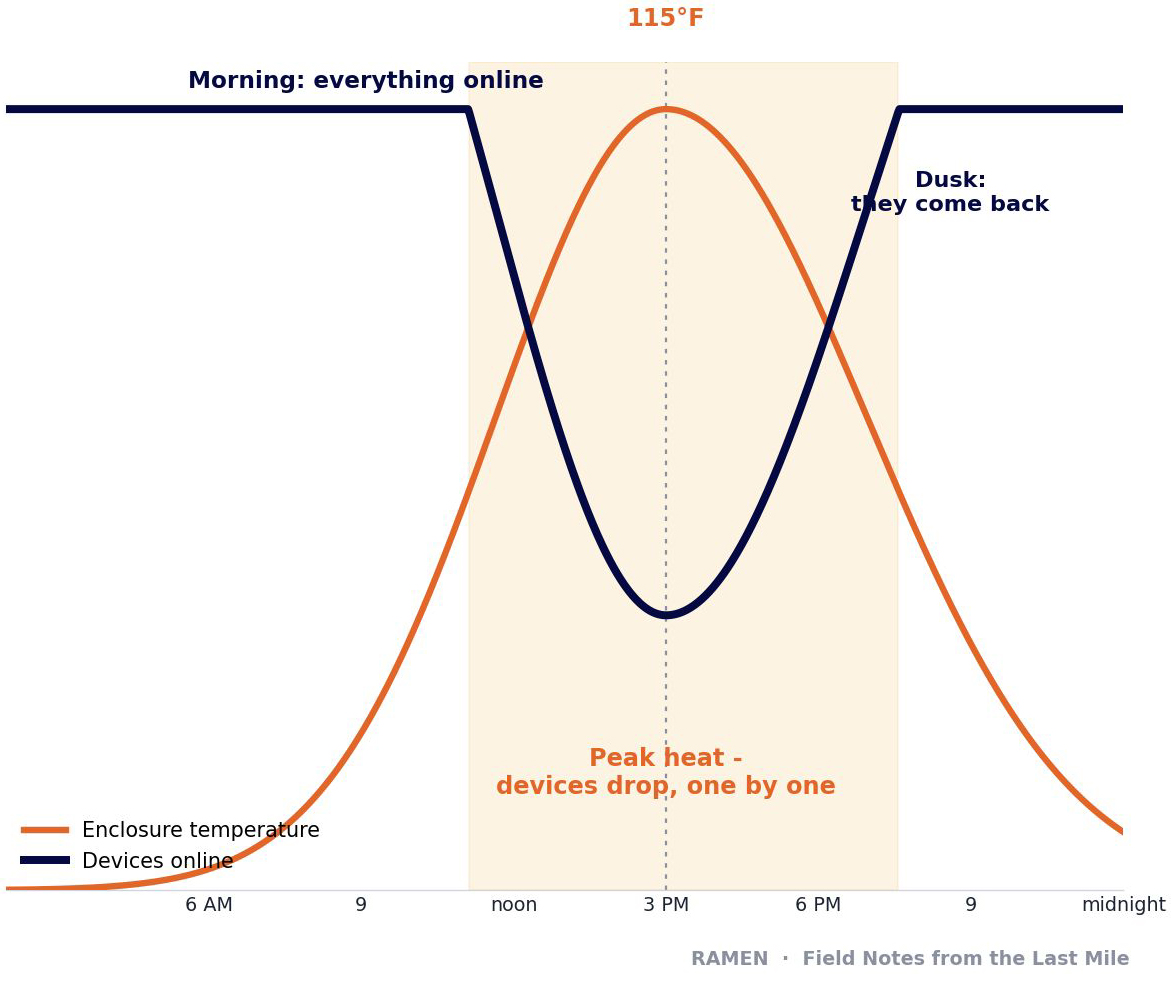
Start with the pattern, because it is almost eerie. The system runs flawlessly all morning. Then, as the afternoon temperature climbs, devices begin dropping offline - not all at once, but one by one. A few hours later, as the sun starts to set, they come back on their own. No software bug behaves like that. No random hardware failure heals itself on a schedule. When the failures track the temperature of the day, the sun is already telling you where to look.
The harder part is that the failure isn’t where instinct sends you. The radios weren’t broken. The software wasn’t crashing. The culprit was one layer deeper. As temperatures rise, every power supply begins to derate - the hotter it gets, the fewer watts it can deliver. This is not a defect and not a bad part; it is basic physics, true of every power supply ever built. Push far enough up the temperature curve and there simply isn’t enough power left to keep the system running reliably, so the most demanding devices brown out and drop. As the day cools, capacity returns, and everything comes back. The heat never attacked the radio. It attacked the electricity feeding the radio.
That is why, in the field, the thermal problem and the power problem are not two problems. They are one. Heat is what quietly shrinks your power budget at the worst possible moment - the hottest part of the busiest day.
There is a second lesson in that desert afternoon, and it is about visibility. Our engineer was standing right beside the equipment and still could not see the problem. It took telemetry from the site, and engineers hundreds of miles away, to overlay temperature, power, and system behavior across an entire day before the pattern became obvious. Being physically present is not the same as having visibility. In harsh, remote environments you need eyes on the system across time - and often those eyes are somewhere else entirely.
Which points at the real conclusion. The hardest problems in Physical AI are rarely solved by replacing hardware. They are solved by understanding how power, connectivity, software, and the environment interact over time, and by designing for that interaction from the start. You model how much power you truly have at the temperatures the enclosure will actually reach, not the ones the lab assumed. You engineer margin from several directions at once - shading and placement to keep the box cooler, airflow to move heat away from where it collects, and lower demand so the system lives comfortably inside its real envelope. And you instrument the whole chain - temperature, power, and device health together - so the failure that hides one layer down cannot hide for long, and so you can watch it from anywhere.
This is the layer we build at Ramen: infrastructure engineered for the environment it actually runs in, and instrumented so its behavior is legible from a thousand miles away. The intelligence on top only delivers if the system underneath survives the real world.
The datasheet tells you how equipment behaves in a laboratory. The desert tells you how it behaves in the real world. Design for the day you actually get.
Field Notes from the Last Mile is a running series on what Physical AI actually takes to deploy in the real world - from the people building it. Subscribe to get the next one.

Explore all of the ways Ramen can benefit your business. Reach out to learn more.
Contact Us